GreenVET pathway

Online GreenVET Path
| ← close |
 |  |  | ||
Sustainability Mission Statement for the School
A sustainability pledge in schools is a formal commitment by the school community to promote environmental responsibility and sustainable practices. It outlines shared values and goals such as reducing waste, conserving energy, protecting natural resources, and fostering awareness among students and staff. This pledge guides daily actions, curriculum integration, and school policies to create a greener, healthier learning environment while empowering students to become active stewards of the planet.Key People and Partners Involved
- School management and teaching staff
- Students and alumni
Description of the practice
Schools can create a sustainability pledge by first engaging the entire school community—students, teachers, staff, and parents—in a collaborative process. This can include workshops, discussions, and surveys to identify key environmental values and priorities that resonate with everyone. Once these core principles are agreed upon, the school can draft a clear, inspiring pledge that outlines commitments such as reducing waste, conserving energy, promoting recycling, and supporting sustainable transportation. Displaying the pledge prominently around the school and including it in orientation materials helps embed it into the school culture.To bring the pledge to life, schools can integrate sustainability goals into everyday activities and curricula. Teachers can design projects that encourage students to practice eco-friendly habits, like organizing recycling drives, energy audits, or planting trees on campus. Staff can implement operational changes aligned with the pledge, such as switching to energy-efficient lighting, reducing paper use, or sourcing sustainable products for the cafeteria. Involving students as “green ambassadors” or sustainability clubs empowers them to lead initiatives, monitor progress, and inspire their peers, fostering a sense of ownership and responsibility.
The impact of adopting a sustainability pledge is multifaceted. Environmentally, schools reduce their resource consumption and carbon footprint, contributing positively to climate action goals. Socially, the pledge nurtures a community culture centered on shared responsibility and respect for the planet, which can improve student engagement and wellbeing. Educationally, it enriches learning by providing practical, real-world applications of sustainability concepts, preparing students to be informed and active citizens. Over time, this commitment builds a legacy of environmental stewardship that extends beyond the school into families and the wider community.
Where it’s being implemented
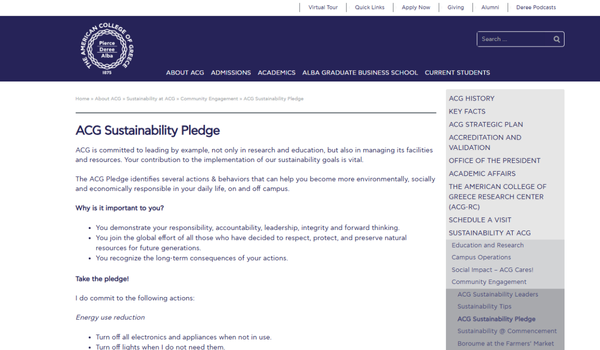
This link might not lead to content in English language. Use your browser's translate function or automatic captions to explore this resource.- The American College of Greece has established a Sustainability pledge for its students, its alumni, its educators and staff. It involves a variety of actions that people pledge to take in order to promote sustainability inside and outside the school.
Furthermore, graduates sign the "ACG Graduation Sustainability Pledge" and wear the ACG Cares green ribbon on their gowns signifying their commitment to advancing sustainability outside campus walls.
https://www.acg.edu/about-acg/sustainability-at-acg/community-engagement/acg-sustainability-pledge/ - The European School Brussels I (Belgium) includes a sustainability mission statement: "The European School Brussels I (EEB1) is committed to integrating sustainability into its core mission, fostering environmental awareness and action among students and the wider school community. The school actively promotes sustainable practices through various initiatives, aiming to cultivate environmentally conscious global citizens."
https://www.europeanschool.be/our-mission/#:~:text=Respectful-,ECOLOGY%20AT%20EEBA,visit%20our%20eco%2Dlabel%20page.
Impact and Results
- Enhanced Student Engagement: Sustainability initiatives boost student participation and leadership, with up to 70% of students reporting increased environmental awareness.
- Improved School Reputation: Demonstrating commitment to sustainability strengthens the school’s image within the community and can attract environmentally conscious families.
- Long-term Behavioral Change: Students develop lifelong eco-friendly habits, influencing their families and communities, thus multiplying the positive environmental effect.
Implementation Tips and Insights
- Involve the Whole Community: Engage students, teachers, staff, and parents from the start to ensure the pledge reflects shared values and fosters collective commitment.
- Make It Visible and Actionable: Display the pledge prominently around the school and link it to concrete activities, goals, and policies that everyone can participate in.
- Monitor Progress and Celebrate Success: Regularly review sustainability actions, share achievements with the community, and recognize contributions to keep motivation high and encourage continuous improvement.


- © 2023 GreenVET | handcrafted & powered with love by GreenVET Team