GreenVET pathway

Online GreenVET Path
| ← close |
 |  |  | ||
Embedding GreenComp in Everyday Teaching
This practice encourages teachers across all subjects to integrate the European GreenComp sustainability competencies into their daily lessons. It empowers students to connect their vocational learning with environmental and societal challenges, fostering a holistic understanding of sustainability.Key People and Partners Involved
- Teachers from various subject areas
- School leadership and curriculum coordinators
- Students
Description of the practice
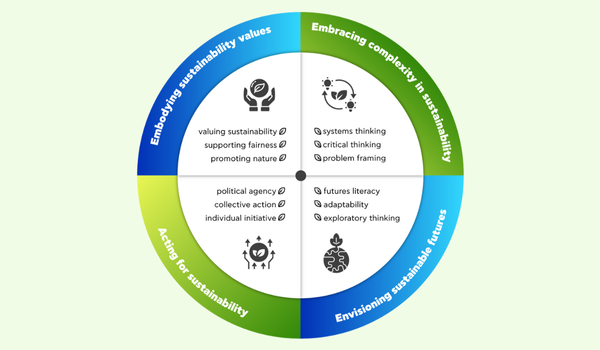
This best practice encourages teachers to embed the GreenComp sustainability competencies into everyday teaching, across all subjects and learning contexts. GreenComp—the European sustainability competence framework—defines a set of knowledge, skills, and attitudes that learners need to live, work, and act in a sustainable way. It is structured around four interrelated competence areas: Embodying sustainability values, Embracing complexity in sustainability, Envisioning sustainable futures, and Acting for sustainability. Teachers are encouraged to use these areas as a lens through which they design lessons, helping students become active contributors to a greener future.Each competence area can be naturally embedded into different subjects. In language classes, students can explore sustainability values and how they are expressed across cultures, fostering empathy and intercultural understanding. In science and technical subjects, students can embrace complexity by analyzing systems like energy supply or food production, learning to navigate uncertainty and interdependence. In economics or social sciences, students can envision sustainable futures by designing green business models or discussing how sustainability will shape future careers and societies.
In practical subjects such as mechanics, culinary arts, or design, students can act for sustainability by creating products and services with a smaller environmental footprint. These hands-on experiences help them apply their skills in real-world contexts, deepen their knowledge of sustainable practices, and cultivate attitudes of responsibility and innovation. By embedding all four GreenComp areas into teaching, schools can ensure that sustainability becomes a lived and practiced value, not just a theoretical concept.
Where it’s being implemented
This link might not lead to content in English language. Use your browser's translate function or automatic captions to explore this resource.Impact and Results
- Increased awareness of sustainability among students and staff
- Cross-curricular integration of environmental and social issues
- Development of students’ critical thinking and systems thinking skills
- Creation of sustainable student projects and prototypes
- Stronger alignment with EU sustainability education goals
Implementation Tips and Insights
- Map existing lessons to GreenComp competencies – Identify where sustainability already exists in your teaching and build from there.
- Use systems thinking tools – Introduce diagrams, models, or simulations to help students understand complexity and interconnections.
- Foster learner agency – Give students opportunities to lead sustainability initiatives or make decisions in projects.
- Integrate reflection activities – Encourage students to reflect on their values, choices, and the impact of their actions.
- Design assessments aligned with GreenComp – Use rubrics that evaluate sustainability-related knowledge, skills, and attitudes.
Useful Links and Resources
This link might not lead to content in English language. Use your browser's translate function or automatic captions to explore this resource. GreenComp The European sustainability competence frameworkhttps://publications.jrc.ec.europa.eu/repository/handle/JRC128040
GreenVET – Sustainability Competence Framework for VET: This resource was developed as part of the GreenVET project and offers practical guidance on how to teach sustainability competencies in vocational education and training (VET). Module 3 is specifically dedicated to the GreenComp framework and includes concrete teaching ideas and examples. The content is available in English, Italian, German, Slovenian, Latvian, and Greek.
https://green-vet.eu/content/framework.php


- © 2023 GreenVET | handcrafted & powered with love by GreenVET Team