GreenVET pathway

Online GreenVET Path
| ← close |
 |  |  | ||
School Composting - Turning Waste into Learning
School composting is a hands-on practice that transforms organic waste into nutrient-rich compost, reducing emissions and supporting school gardens. Beyond waste reduction, it offers students real-life learning about ecological cycles, circular economy, and environmental responsibility.Key People and Partners Involved
- students
- teachers
- school facilitation
Description of the practice
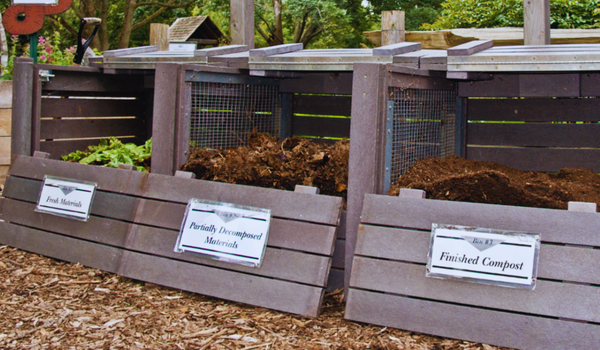
School composting is a simple yet impactful way to reduce organic waste and create valuable compost for gardens and green spaces on campus. By collecting food scraps, garden clippings, and other biodegradable materials, schools can significantly cut down on the amount of waste sent to landfill and reduce emissions from waste transport. The resulting compost enriches soil health, supports biodiversity, and helps close the nutrient loop right on school grounds.More than just a waste solution, composting is also a powerful educational tool. It allows students to observe biological processes firsthand—such as decomposition, nutrient cycling, and the role of microorganisms. Through active participation in composting activities, learners gain a deeper understanding of sustainability topics including soil health, the circular economy, and climate action. These connections can be integrated across subjects such as science, geography, and even economics.
Involving students in composting also fosters a sense of responsibility and agency. When students help manage waste and see the direct outcomes of their efforts—like healthier plants or reduced trash—they develop a stronger connection to environmental stewardship. Composting can be easily scaled, from a classroom worm bin to a whole-school system, making it an accessible and flexible entry point for embedding sustainability into everyday school life.
Where it’s being implemented
This link might not lead to content in English language. Use your browser's translate function or automatic captions to explore this resource.- The San Benedetto – Einaudi – Mattei High School in Latina (Italy) has implemented an Eco-School project in the 2023/2024 school year. The initiative emphasizes education for sustainability, encouraging correct behaviors in respect of the environment and the community, and the environmental management of the school by adopting good practices to reduce its environmental impact and achieve savings in consumption. The school also aims for the international “Green Flag” certification once goals are met.
- The Eco-School project in Latina also has a presence on social media, including a video on Facebook highlighting some of the school’s activities and their environmental education initiatives.
Impact and Results
- Reduced Waste Volume – Composting decreases the amount of organic waste sent to landfill, helping schools cut down on overall waste output. .
- Lower Greenhouse Gas Emissions – It reduces methane emissions from landfills and cuts carbon emissions linked to waste transport.
- Improved Soil Health – The resulting compost enhances soil quality in school gardens, supporting plant growth and biodiversity.
- Hands-On Environmental Education – Students learn about decomposition, ecosystems, and sustainability through active participation.
- Increased Student Engagement and Ownership – Involving students in composting fosters a sense of responsibility and connection to environmental action.
Implementation Tips and Insights
- Start Small – Begin with a pilot project like a classroom compost bin or a small outdoor pile to build experience and engagement.
- Choose the Right System – Select a composting method that fits your school’s space, climate, and waste type—such as worm bins (vermicomposting), tumblers, or traditional piles.
- Educate and Train – Provide lessons or workshops for the whole school community (teachers, students, kitchen staff, janitors) on what can be composted and how to maintain the system to avoid contamination.
- Connect to the Curriculum – Integrate composting into subjects like science, geography, and economics to reinforce learning outcomes.
- Scale Up to a Community Compost – Once established, explore partnerships with local residents to expand the project and serve the wider community.
Useful Links and Resources
This link might not lead to content in English language. Use your browser's translate function or automatic captions to explore this resource. The students of the San Benedetto High School in Latina join the celebration of #EarthDay with photos showing their compost management work:https://www.facebook.com/ecoschoolslatina/videos/599522707672359/"rdid=T02w8rbG2Ryen3xl
The American Institute for Self-Reliance published a toolkit for schools on how to implement and maintain a 3-bin-composter in schools:
https://ilsr.org/articles/ilsr-guide-to-composting-onsite-at-schools/"utm_source=chatgpt.com
This guide by the Central Vermont Solid Waste Management District contains project-based learning activities from grade 2-12 around composting.
https://www.cvswmd.org/uploads/6/1/2/6/6126179/do_the_rot_thing_cvswmd1.pdf


- © 2023 GreenVET | handcrafted & powered with love by GreenVET Team