GreenVET pathway

Online GreenVET Path
| ← close |
 |  |  | ||
Online tools to calculate school's consumption
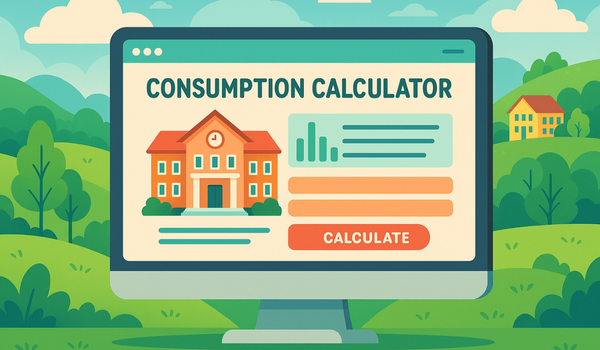
Using online tools to measure a school’s resource consumption—such as energy, water, waste, and travel—helps identify environmental impacts, supports data-driven decision-making, and engages the whole school in sustainability planning.Key People and Partners Involved
- School administrators and facility managers
- Eco-coordinators and teachers
- Students (especially in STEM or eco clubs)
- Municipal partners or NGOs
Description of the practice
Online consumption calculators allow schools to assess their environmental impact by tracking energy use, water consumption, waste generation, and carbon emissions from transport and food. These tools offer clear insights and often generate reports or recommendationsBy visualizing real data, schools can identify priority areas for improvement"such as heating efficiency, reducing plastic use, or encouraging sustainable commuting. Students can take part in audits, analyze results in class, and propose solutions
Using calculators fosters transparency, supports applications for eco-certifications (like Eco-Schools), and allows progress tracking over time. It transforms sustainability into an evidence-based, participatory practice embedded in school culture
Where it’s being implemented
This link might not lead to content in English language. Use your browser's translate function or automatic captions to explore this resource.- The GAIA project created a network of 25 pilot schools across Greece, Italy, and Sweden equipped with IoT infrastructure (sensors and meters) to monitor energy use, indoor/outdoor conditions and other environmental variables.
gaia-project.eu he data is collected in teaching rooms and common areas to help schools understand how resources are used and where efficiency improvements are possible.
https://gaia-project.eu/index.php/en/trial-schools/ - The climate calculator was jointly developed by Greenpeace and the Institute for Energy and Environmental Research Heidelberg (ifeu), with contributions from 15 pilot schools across Germany. It is a free online tool that allows schools and daycare centers to calculate their resource consumption in areas such as heating, electricity, water, mobility, food, materials, and waste. The results make the potential for savings and sustainability improvements visible to the entire school community.
https://co2-schulrechner.greenpeace.de/willkommen - Provides downloadable audit templates and carbon calculators for schools participating in their environmental programs.
https://greenschoolsireland.org/resources/
Impact and Results
- Increased student engagement in environmental monitoring
- Greater success in obtaining green certifications
- Community awareness of school's environmental efforts
- Long-term cost savings through
- Clear data on school's resource usage and emissions
Implementation Tips and Insights
- Start with one domain (e.g., energy or waste)
- Assign a team (teachers + students) to input and track data
- Use historical utility bills to compare progress
- Display results publicly to motivate action
- Link findings to classroom learning (math, geography, science)
Useful Links and Resources
This link might not lead to content in English language. Use your browser's translate function or automatic captions to explore this resource. Footprint calcultatorhttps://footprint.wwf.org.uk/


- © 2023 GreenVET | handcrafted & powered with love by GreenVET Team