GreenVET pathway

Online GreenVET Path
| ← close |
 |  |  | ||
Sustainable Development Certificate
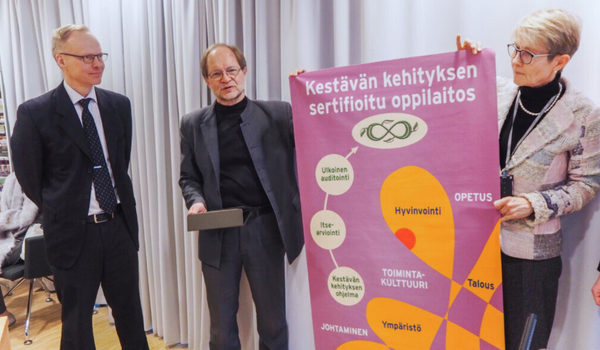
Several European countries offer formal sustainability certification schemes open to TVET institutions, often integrated into national or international Education for Sustainable Development (ESD) frameworks. These schemes typically assess how environmental, social, and economic sustainability principles are embedded in curricula, operations, and governance.Key People and Partners Involved
- School management and teaching staff
- Students
- Certification authorities or initiatives
Description of the practice
In Finland, the OKKA Foundation grants a national Sustainable Development Certificate to vocational and adult education institutions that demonstrate holistic integration of sustainability. VET institutions in Germany can earn the UNESCO-endorsed ESD Award or participate in the “Umweltschule in Europa” (Eco-Schools Germany) programme.Across other European countries, VET institutions actively engage in sustainability certification, most commonly through Eco-Schools or national ESD frameworks. These certifications promote whole-institution approaches aligned with the SDGs, enhancing environmental literacy, community engagement, and green skills development in vocational education.
Where it’s being implemented
This link might not lead to content in English language. Use your browser's translate function or automatic captions to explore this resource.- Omnia, a vocational college in Espoo, earned the certificate for incorporating circular economy principles across its learning environments and business education.
https://www.omnia.fi/en/about-omnia/sustainable-future
Impact and Results
- Whole-institution integration: Sustainability principles embedded in curricula, daily operations, and governance
- Quality assurance in Education for Sustainable Development: A structured, transparent framework to evaluate and continiously improve sustainability practices
- Recognition and credibility: Formal certification that demonstrates commitment to sustainable development at national and international levels
- Stakeholder engagement: Stronger participation of students, staff, and local community in sustainability actions and decision-making
- Building networks: Certification creates opportunities to connect with peers from the educational sector
Implementation Tips and Insights
- Assess your school's current practices: Review curricula, operations, and policies to identify gaps against certification criteria.
- Create a sustainability team: Involve teachers, staff, and students to coordinate projects and monitor progress.
- Document and improve: Keep records of activities, track outcomes, and regularly adjust practices to meet certification standards.
- Use certification for broader development: Treat the process as a tool to guide continuous improvement across the whole school.
- Learn from others: Visit schools that are already certified to exchange experiences and best practices.
Useful Links and Resources
This link might not lead to content in English language. Use your browser's translate function or automatic captions to explore this resource. The certification of climate schools in Germany is carried out in a decentralized manner—mostly through state-level programs (e.g., Hamburg, Saxony), within the framework of Education for Sustainable Development (ESD) initiatives, or with the support of NGOs. It is worthwhile to check at the state level which programs or awards are offered. For Saxony:https://www.klima.sachsen.de/klimaschulen-in-sachsen-12616.html
The Eco-Schools programme, coordinated globally by the Foundation for Environmental Education (FEE), empowers students to take an active role in improving environmental practices at school and in their communities, guiding them towards Green Flag certification while fostering lasting sustainability awareness and action. The programme is currently active in 101 countries worldwide. For a complete list of participating countries and their national operators, and for guidance on implementing Eco-Schools in your institution, visit the official Eco-Schools website:
https://www.ecoschools.global/


- © 2023 GreenVET | handcrafted & powered with love by GreenVET Team